Deep in the William O Douglas Wilderness, east of Mt Rainier National Park, our wolverine mama, Pepper is raising two young kits.

5.21.2018
Wolverine kits documented in the South Cascades for the first time in many decades.
Deep in the William O Douglas Wilderness, east of Mt Rainier National Park, our wolverine mama, Pepper is raising two young kits. See Seattle Times article.

On May 16th, our field crew returned from a 3-day snow camping trip into this remote, mountainous habitat with exciting news. Scott, Kayla, and I retrieved photos and video of Pepper and her kits from the den. This is the first reproductive wolverine den documented in Washington’s southern Cascade Range (Cascades south of Interstate 90) and the 3rd den in the state in over 50 years.


In North America, wolverine kits are typically born in mid to late February so these kits are likely 2.5 to 3 months old today.


The crew first discovered the den after wolverine experts examined photographs from the monitoring station, and determined that Pepper was lactating and thus raising young nearby. They followed wolverine tracks to the den after extensive searching.

They also followed tracks to several snow holes, where the wolverines had cached prey items deep in tree wells that act like refrigerators. These snow holes, where wolverines can keep food from rotting, are thought to be one of the reasons why wolverines rely upon snow for their survival.

During the last night of the trip - the 4th visit for Scott and Kayla - we were woken to a sniffing sound close to our tents. The next morning, we discovered fresh wolverine tracks in the snow under my socks that I had hung to dry on a branch, 4-ft from my tent.

Our goal is to document the natural recolonization of wolverines into southern
Washington and improve our understanding of how climate change threatens this
rare and elusive carnivore.
Pepper and her 2 kits outside the den
On May 16th, our field crew returned from a 3-day snow camping trip into this remote, mountainous habitat with exciting news. Scott, Kayla, and I retrieved photos and video of Pepper and her kits from the den. This is the first reproductive wolverine den documented in Washington’s southern Cascade Range (Cascades south of Interstate 90) and the 3rd den in the state in over 50 years.
Pepper's mate, an unknown male, at the den entrance
One of Pepper's kits, likely 3 months old today
In North America, wolverine kits are typically born in mid to late February so these kits are likely 2.5 to 3 months old today.
Pepper displaying her unique chest blaze at a monitoring station
An unknown male, likely Pepper's mate, displaying his unique chest blaze
Previously, Scott and Kayla, our determined field crew, had gone above and beyond the call of duty to set a wildlife monitoring station far out in the wilderness. The station is designed
specifically to identify individual wolverines from photographs based on their
unique chest blaze and determine the wolverine’s sex, and possibly, its
reproductive status. Here, they detected both the female wolverine nicknamed
Pepper and an unknown male, which we assume is her mate.
Scott and Kayla arriving at the den to check the cameras
The crew first discovered the den after wolverine experts examined photographs from the monitoring station, and determined that Pepper was lactating and thus raising young nearby. They followed wolverine tracks to the den after extensive searching.
Scott looking for prey remains at a melted out snow cache - a "wolverine refrigerator"
They also followed tracks to several snow holes, where the wolverines had cached prey items deep in tree wells that act like refrigerators. These snow holes, where wolverines can keep food from rotting, are thought to be one of the reasons why wolverines rely upon snow for their survival.
Fresh wolverine track at our camp
During the last night of the trip - the 4th visit for Scott and Kayla - we were woken to a sniffing sound close to our tents. The next morning, we discovered fresh wolverine tracks in the snow under my socks that I had hung to dry on a branch, 4-ft from my tent.
Wildy, the first wolverine documented south of I-90 in modern times
5.02.2018
First wolverine mama in southern Washington in many decades.

Pepper's unique chest blaze.
In collaboration with the United States Forest Service (Naches Ranger District), we have documented a reproductive female wolverine, south of Interstate Highway 90 (I-90) in Washington's Cascade Range for the first time in a long time. We nicknamed her Pepper and she is also the first female wolverine documented south of I-90 in many decades. We first detected Pepper in 2016 at 2 wildlife monitoring stations on the Naches Ranger District. We collected hair samples from her in 2017 at another station as part of the Western Wolverine Conservation Project. Her DNA was genotyped to give her a unique ID, F37. This April, she was photographed at one of our runpole monitoring stations. From photographs, we confirmed with wolverine experts that she is lactating and therefore has kits (as long as they remain alive).

Pepper’s
belly showing enlarged teats, evidence of lactation.
Our field crew followed Pepper's snow tracks along with a larger set of tracks, presumably of a male, and we detected a male wolverine at the same station as Pepper was detected as well as at a second station in the vicinity.

Unknown male at another wildlife monitoring station.
Wolverines are slowly gaining
ground in Washington after having been extirpated from the state in the 1950s due
to excessive human-caused mortalities associated with predator control programs; however, their distribution had been largely confined to the
North Cascades Ecosystem (NCE), north of I-90. As some of you may remember, the Yakama Nation made the first detection of a wolverine south of I-90, on the east slopes of Mt Adams in 2006. This was the impetus for founding the Cascades Carnivore Project. Now, this most recent evidence of a lactating female
is the first indication that wolverines might be re-establishing themselves in the southern Washington Cascades. And while this is good news
for wolverines and for wolverine conservation, there is evidence that their abundance throughout
the contiguous United States is very low. In addition, they face new threats from by climate
change and increased recreation.
Wolverines! Not only one individual in Washington's southern Cascades anymore.
It has been a busy winter. Scott and Kayla, our main field crew, have done an incredible job getting out to the remotest parts of our southern Washington study area (Mt Adams to Mt Rainier) into the heart of wolverine habitat.


We have begun using runpole stations as our newest survey tool. These are wildlife
monitoring stations designed specifically to photographically identify
individual wolverines based on their unique chest blaze and determine their
gender, and possibly reproductive status. They also collect hair samples for DNA analyses. They were designed by wolverine researcher, Dr. Audrey Magoun, who knows more about wolverines than almost anyone else and has creatively designed these stations. The stations are set 10+ feet up a tree so they stay above the snowpack as winter progresses. Additionally, we have added features to ensure the detect Cascade red foxes. They also work well for detecting other rare carnivores such as fishers and Pacific martens. These stations require a bit more up front effort, especially while we got the hang of things, but they have the potential to provide valuable information that would otherwise require live-trapping individuals. Our goal is to determine whether wolverines are reproducing south of Interstate Highway 90 (I90) in the Washington Cascade Range.
Scott setting up the hair snagging device on the runpole.
Wolverine country.
First wolverine detected at a runpole station by our study.
x
10.27.2017
North Cascades Project

Hiking up into the Sawtooth-Lake Chelan Wilderness.

A far bit of snow up above 6000 ft.

Bobcat tracks on the trail.


Note to self: If I drive all the way from my parent's home in Vancouver, BC over the Cascade Crest and try to accomplish something in the field, I will be hiking out of the wilderness after dark.

10.09.2017

8.20.2017
Special Recognition Award from the Western Association of Fish and Wildlife Agencies

This past winter, I was part of Washington's field team for the Western Association of Fish and Wildlife Agencies (WAFWA) wolverine survey. The Western States Wolverine Conservation Project was developed by the WAFWA Wildlife Chiefs' Wolverine Sub-Committee as part of "a statistically defensible multi-state monitoring plan for states where wolverine populations exist (WY, MT, ID, WA)".
At the recent annual meeting of the Western Association of Fish and Wildlife Agencies, the Washington Department of Fish and Wildlife's Assistant Director, Eric Gardner accepted a special recognition award for the Wolverine Project’s Washington Team.
In accepting the award, he stated: "In Washington, we did things a little different than they did in Montana, Idaho and Wyoming. We did not hire crews to conduct the project’s wolverine survey because we are fortunate to have a group of highly skilled and very experienced biologists from a number of different organizations that were already heavily invested in wolverine conservation and surveys, and who were interested in helping on the project’s wolverine survey. Given the skills, dedication, resourcefulness and incredible toughness of these biologists, working together on the project was clearly the best strategy for success. Accordingly, this award recognizes their hard work, their boundless interest and energy, and their dedication to wolverine conservation. They are: Scott Fitkin, Jeff Heinlen, Jeff Lewis, Paul Debruyn, Fenner Yarborough, David Volsen, and Hannah Anderson from WDFW; John Rohrer, Aja Woodrow, Don Youkey, Matt Marsh, Sonny Paz, Phyllis Reed, and Jesse Plumage from the Okanogan-Wenatchee and Mount Baker-Snoqualmie National Forests; Robert Long from Woodland Park Zoo; Jocelyn Akins from the Cascade Carnivore Project; Roger Christophersen from North Cascades National Park, and Drew and Cathy Gaylord from Conservation Northwest. When you run into these folks, don’t hesitate to ask them about the project; because they have some amazing stories to tell."

Getting the snowmobiles endlessly stuck.
7.27.2017
Cascade Mountain School Fox Hunt
On July 25, 2017, we headed up Stagman Ridge Trail to Horseshoe Meadow on Mt Adams to meet with a group of 14-17 year old students from Cascade Mountain School. We had a bug-attacked talk about ecosystems, ecological niches, Cascade red foxes, and the fisher re-introduction. There were ALOT of mosquitoes and black flies but also incredible vistas of the snow-bedecked mountain and lush, expansive subalpine meadow full of bright red and pink Paintbrush wildflowers. The students went into the meadow and surrounding ridges to set remote cameras in the hopes of detecting Cascade red foxes into the late summer and fall. I was joined on my hike by my friend, Victoire from Normandy. The trail meanders through the 2012 Cascade Creek Fire, which converted dense, shady mid-elevation Douglas Fir and Western Hemlock forests into bright, hot tinder and dead trees, now replete with the most vibrant and diverse wildflowers.


Cascade Mountain School students divided into 3 groups.
Group #1: Courtney, Owen, and Luca chose a spot for their remote camera based mostly on the Cascade red fox's attraction to water, and also because the fox will be in full camera range. They set the scent lure on an out-reaching branch across from the camera so the fox would be in full exposure to be caught on camera. It was also a slightly secluded area so there were less animals that may be attracted to the scent, that way other animals would be less likely to trigger the camera.
Group #2: Max, Quinn, and Shiah ventured out with scat collecting bags, a camera trap, and some scent to attract the fox. They found a game trail located on the saddle west of Horseshoe Meadow. The area was lightly treed and also near the edge of the meadow. They placed their remote camera in a tree near where they thought the fox might travel. Then on a tree across from the camera, they placed the scent to lure the foxes in.
Group #3: Clark, Jayvahn, and Oliver placed their camera in a place with many animal tracks near the creek. They believed that the site will have a lot of foot traffic and will eventually draw a fox because of abundant prey and easy access to water.
Cascade Mountain School students divided into 3 groups.
Group #1: Courtney, Owen, and Luca chose a spot for their remote camera based mostly on the Cascade red fox's attraction to water, and also because the fox will be in full camera range. They set the scent lure on an out-reaching branch across from the camera so the fox would be in full exposure to be caught on camera. It was also a slightly secluded area so there were less animals that may be attracted to the scent, that way other animals would be less likely to trigger the camera.
Group #2: Max, Quinn, and Shiah ventured out with scat collecting bags, a camera trap, and some scent to attract the fox. They found a game trail located on the saddle west of Horseshoe Meadow. The area was lightly treed and also near the edge of the meadow. They placed their remote camera in a tree near where they thought the fox might travel. Then on a tree across from the camera, they placed the scent to lure the foxes in.
Group #3: Clark, Jayvahn, and Oliver placed their camera in a place with many animal tracks near the creek. They believed that the site will have a lot of foot traffic and will eventually draw a fox because of abundant prey and easy access to water.
4.25.2017
Large carnivores.
Being a mesocarnivore ecologist
(someone who studies mid-sized carnivores), I am constantly stunned by how majestic
and beautiful large carnivores are. We collected these photos of a mountain
lion in December at the beginning of our winter field season. They are the only
shots we received of a mountain lion from our mountain carnivore project.
Mountain lions are just so… plain wild! I've also added a couple of my favorite photos of large carnivores from the archives.


4.03.2017
Visits from the Cascade red fox color morphs this winter
While red foxes come in a variety of coat colors, or phases, there are three typical colors phases. The coat of a red fox does not change color with the seasons but rather stays the same throughout its year and lifetime. The cross-phase Cascade red fox, is distinguished by a dark band running down its spine and across its shoulders, forming a cross.


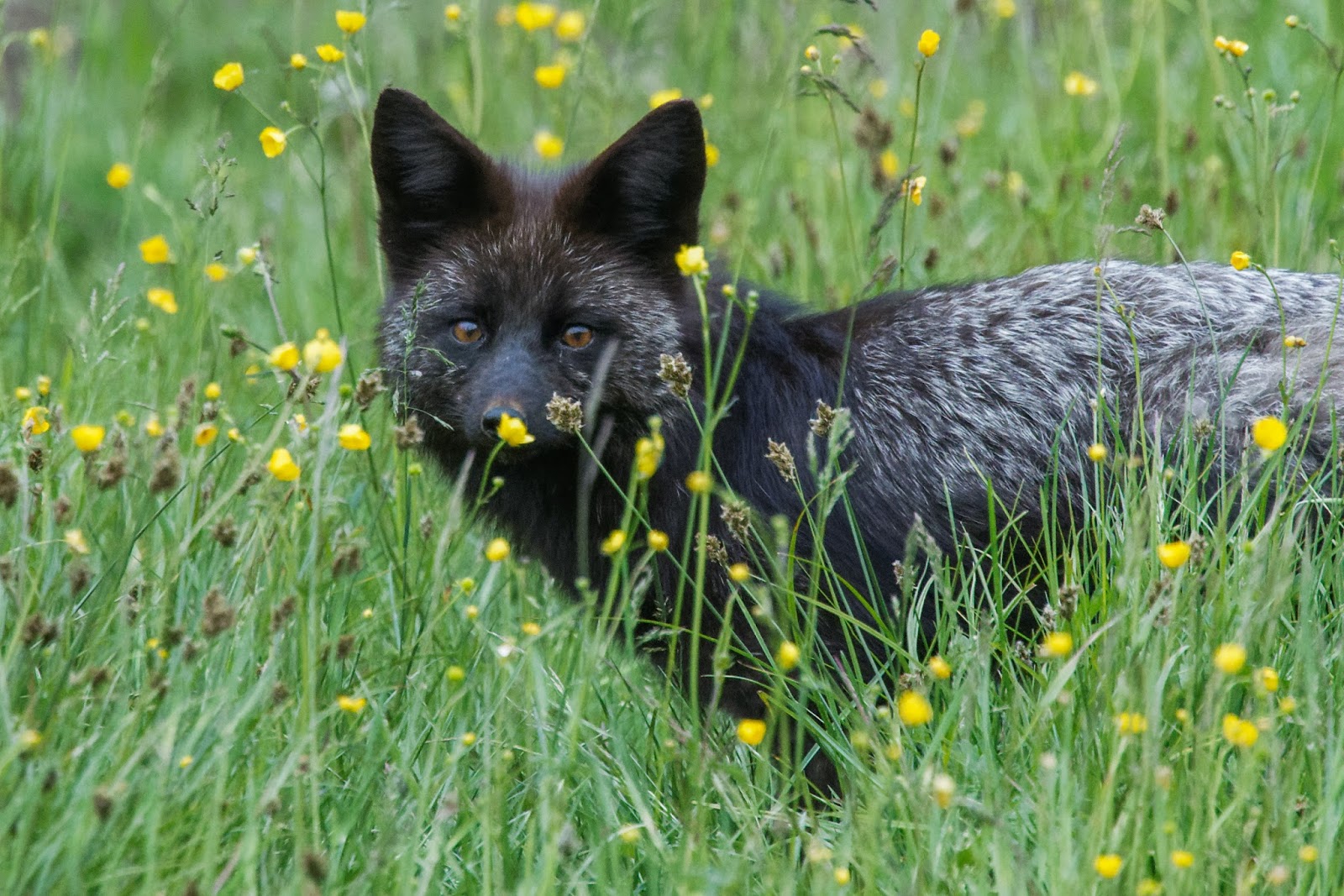
The black-phase Cascade red fox, also known as a silver fox, is grizzly black and white. This individual was photographed in the Crystal Mountain area.


The better known red-phase Cascade Red Fox

A night comparison of cross-phase and red-phase Cascade red foxes


3.15.2017
Deep, deep winter

This has been quite the winter. Endless snow, which seems to always fall most heavily at the beginning of the month when we are trying to get out for our monthly camera checks, have hampered our best intentions. This latest cycle of high avalanche danger has made getting out near impossible as we value our lives. On top of the weather, we have had some interesting set backs including a flat tire, a wheel rolling of the trailer, a blown snowmobile cylinder, my getting the truck stuck in deep snow in the snowpark; erratic, old snowmachines, what else? I can't remember but I know there was more.
2.02.2017
Video of a black-phase Cascade red fox
Thanks to Doug Carlton for capturing this black-phase Cascade red fox at Crystal Mountain Resort and telling us about it. This is individual is likely one of the foxes that was photographed this summer near a den we were monitoring in the area.

Let us know if you have seen a fox in the Cascades.
1.27.2017
Winter Cascade red fox and wolverine surveys commence
We began Year 2 of our Winter Rare Carnivore Project collaboration with the USFS Naches Ranger District in November 2016 and results are coming in.

Looking down into drainage.

Classic, subalpine, ridge-line Cascade red fox habitat.

Veronica and Cascade red fox tracks near one of our stations.
Looking down into drainage.
Classic, subalpine, ridge-line Cascade red fox habitat.
Veronica and Cascade red fox tracks near one of our stations.
1.10.2017
Fishers in Washington
December was an exciting month for the Pacific Fisher in Washington! On December 2nd, as part of Washington State's Fisher Recovery Plan, ten fishers from British Columbia were released into Mt. Rainier National Park. Releases continued in Gifford Pinchot National Forest on December 10th, with more releases occurring in both areas throughout the rest of the month
Having been essentially extirpated in Washington around the 1930's from extensive trapping and habitat loss, the fisher was determined as endangered in the state in 1998. From there, a statewide reintroduction effort was devised, kicking off with the release of 90 fishers throughout the Olympic Peninsula between 2008 and 2011. While these fishers were continuing to be monitored, reintroductions began in Washington's Southern Cascades last year, with the release of 23 total animals, in the Gifford Pinchot National Forest. Of these 23, fisher M007 has drawn the attention of locals within the Naches Ranger District. This March, M007 was caught on a Conservation Northwest Citizen Monitoring camera, roughly 50 miles Northwest of the release site. You can read more about his detection here:
In mid-December, M007 was seen by a local cabin resident roughly 20 miles South of his previously photographed location and then spotted on a separate occasion in a nearby drainage less than two weeks later.
Throughout this winter, releases will continue in Mount Rainier National Park and Gifford Pinchot National Forest until a total of 80 individuals have set out into the Southern Cascades. In the winters following the Southern releases, a final reintroduction effort will begin in the North Cascades area with another 80 animals. Recovering a healthy fisher population in Washington may be slow as the new fishers adjust to challenges like habitat fragmentation, but the effort and support going into their reintroduction is very exciting! As low to mid elevation carnivores, we don't expect to detect fishers on our camera traps primarily set for high elevation carnivores, yet it is not out of the realm of possibilities and we'll be keeping an eye out for their sign!
You can stay updated on the reintroduced fishers on WDFW's page: http://wdfw.wa.gov/
12.24.2016
Observing group behavior in Cascade Red Foxes
While monitoring the Crystal Mountain area last winter, we were lucky enough to observe 5-6 Cascade red foxes occupying overlapping home ranges. We believe that this fox group is composed of a mother with 2 pups, 2 yearling foxes, and perhaps the father. With lowland foxes, where more is known, it is not uncommon for young from a previous breeding season to continue sharing an area with their parent, where they act as support for pup rearing and security for the den and range. Much about the behavior of montane red foxes, though, is unknown because of the little research that has been conducted on these subspecies. For example, there have only been a handful of mountain red fox dens documented throughout the world, but since the start of this project we have found four of them! Considering that mountain foxes have evolved separately from lowland foxes for the past 300,000 years leading them to possess unique habitats and diets, we do not yet know how their behaviors compare and differ. Each Cascade red fox behavior we observe contributes to the little knowledge base on mountain foxes and is hugely exciting for us!

 (c) Anthony Carado
 (c) Anthony Carado
Complementary to our observations of the family group occupying the Crystal Mountain area, within the Naches Ranger District we monitored a breeding pair that frequented three camera stations from early March to the camera takedowns in late August. In mid August, we detected an additional fox, believed to be a yearling, at two of those camera stations and within the assumed home range of the breeding pair. It's possible that this fox is participating in the same group behavior as the Crystal foxes. Soon we will return to the area to reset cameras, following up on its locals. Below is a video of the Naches pair and a detection of the young fox.

This upcoming season we will return to the Crystal Mountain area to continue monitoring its local foxes and their dynamics.

(c) Anthony Carado

Complementary to our observations of the family group occupying the Crystal Mountain area, within the Naches Ranger District we monitored a breeding pair that frequented three camera stations from early March to the camera takedowns in late August. In mid August, we detected an additional fox, believed to be a yearling, at two of those camera stations and within the assumed home range of the breeding pair. It's possible that this fox is participating in the same group behavior as the Crystal foxes. Soon we will return to the area to reset cameras, following up on its locals. Below is a video of the Naches pair and a detection of the young fox.

10.14.2016
Crystal Mountain Fox Den
We have had a successful season monitoring the foxes around the Crystal Mountain area! Not only were we able to observe 4-5 local foxes, we have additionally been monitoring a den system in the area. One of our remote cameras, situated at a den entrance, yielded exciting detections of a black-phase mother and two pups, up until July 31st when they abandoned the den. Instead of maintaining dens throughout the year, montane red foxes use dens primarily as a means for rearing kits, abandoning them once the young are more self-sufficient and returning to them or developing new systems with the return of mating season.


Shortly after becoming vacant, the den was briefly entered by an elusive mountain beaver. This lesser known rodent, weighing only a few pounds, is not closely related to the North American beaver, but is the sole living member of its biological family, Aplodontiidae. Primitive traits like inefficient kidney functions, early cranial-muscular features, and an inability to conserve body heat as effectively as other rodents, make the mountain beaver somewhat of a “living fossil.” The mountain beaver is believed to be in abundance in its Pacific Northwest range from British Columbia’s Cascades, to the Olympic and Coastal mountains of Washington and Oregon, and as far South as the Sierra Nevada mountains in Northern California, occurring as 7 different subspecies. Living most of its life underground in burrow systems similar to fox dens, this mountain beaver seemed to be investigating the new real estate.

Subscribe to:
Posts (Atom)