5.04.2012

Series of montane red fox detections on Mt Hood, Oregon

These photos are the latest in a series of recent detections on the south side of Mt Hood, Oregon by Cascadia Wild and the Cascades Carnivore Project in cooperation with the Mt Hood National Forest. In addition to a black-phase fox photographed by Jon Dierickx in 2011, this red-phase fox and a black-phase fox detected in March, 2012 mark the first detections of montane red foxes in northern Oregon in many decades. Mt Hood, Crater Lake, and the Siskiyou Mountains are the only locations where montane red foxes are known to occur in Oregon. If you have seen a fox in the mountains of Oregon or Washington, please send me a line.

2.17.2012

Photo of the day: Cascade red fox pup at Mt Rainier


Photo: Logan Volkmann, Simon Fraser University

1.29.2012

CCP has an immediate opening for a full-time volunteer!


Cascade Red Fox and Wolverine Snow Tracking Volunteer Position

The Cascades Carnivore Project has an immediate six-week volunteer opening for an extremely fit field member.

Qualifications: high physical fitness, advanced snowmobile rider

Dates: Feb.13 to March.27

Duties: Following Cascade red fox and wolverine tracks in snow. Setting and checking wildlife camera stations. Collect genetic samples including scat, hair, urine, and roadkill. Operating a snowmobile 3+ hours a day. Snowshoing up to 10 miles a day. Office duties including project planning, data entry, data analysis, and photo cataloging.

Accommodation: Mt Adams Ranger Stations in Trout Lake, WA; at remote field cabin; possible winter camping.

Transportation: work truck, trailer, and 2 snowmobiles. Applicant must have personal vehicle to get to and from study area.

Details:
The work is extremely strenuous and demanding. You will be expected to snowshoe up to 10 mile a day and snowmobile 3+ hours a day. You must be in strong physical fitness. We can not accept anyone who is not currently in top physical condition and able to trudge long distances in deep snow.The conditions are often snowy, rainy, warm, and extremely cold. So you need to bring appropriate personal field gear:

* FULLY waterproof rain jacket or parka,
* FULLY waterproof ski pants
* waterproof, insulated winter boots for snowshoeing (not hiking boots)
* big, high quality winter mitt
* very warm winter hat
* neck gaiter
* all the under layers
* all other personal gear that you can think of

If you are interested in the position, please email Project Coordinator, Jocelyn Akins at cascadescarnivore@gmail.com, detailing how you meet the qualifications. Please send a recent photo of yourself. No phone calls please.

12.14.2011

Winter Season 2011/2012 kicks off


We have begun our winter survey season with wildlife camera stations and snow tracking on Mt. Adams. Teri and Imogene will be checking cameras and tracking across regions of the mountain where we have detected the Cascade red fox since we begun the study in 2008.

After our January kick-off on Mt Adams, we will move to Mt St Helens for February, and on to Mt Rainier for March snow tracking and wildlife camera detections. These winter surveys will be followed by spring surveys at known fox dens on Mt Rainier and summer scat collection along trails across the Gifford Pinchot National Forest and Mt Rainier National Park.

We will assemble a cadre of volunteers this spring so keep in touch if you are interested in collecting fox poo and hiking in gorgeous locations in the Washington Cascades.

11.12.2011

2011/2012 Winter surveys begin


With the kick-off of our winter field season in September, we were amazed to have already captured a Cascade red fox by photograph on the south side of Mount Adams. We will be snow tracking in areas where we know foxes are living in order to collect genetic samples as well as data on their movements during winter and those of their greatest competitor and predator - the coyote. Our efforts will take us to Mount Adams and Mount Rainier.

2011 Mt St Helens and the Dark Divide


This summer a crew of two - Polly Gibson from Portland, Oregon and Darryl Johnson from Corvallis, Oregon - conducted remote camera surveys on Mt St Helens and the Dark Divide Roadless Area to investigate whether the Cascade red fox exists in these areas. The Dark Divide remains one of the most remote parts of the Gifford Pinchot National Forest, receiving very few visitors. The dirt bike access and rutted trails ensure less hikers than many other parts of the forest. The Dark Divide is characterized by picturesque steep ridges and rocky outcrops that jut above treeline as ambling, grassy knolls. Their berry-clad slopes descend precipitously into thick forest ending in large streams that flow north to the Cispus River and south to the Lewis River, one of the major streams that drains Mt Adams. There are many ideal spots for a fox to make its home along the flat-topped ridges; good denning and foraging habitat. The Dark Divide is a high-elevation piece of land that connects Mt Adams to Mt St Helens, and may serve as a corridor for dispersal between the two mountains if foxes do indeed inhabit Mt St Helens. This is one of the major questions posed by my doctoral research. Mt St Helens is rather different from Mt Adams. It lost most of its alpine habitat by the 1980 eruption, and the former dense mid-elevation boreal-type forest is now blow down that has created an open, alpine-style landscape. Whether the habitat characteristics that the fox depends upon in the alpine ecosystem of Mt Adams exist in this alpine-esque lower elevation space is unknown. If the fox does inhabit Mt St Helens, its presence there will provide a better understanding of these specific habitat requirements, such as snowpack thickness, canopy cover, and presence of predators and competitors such as the coyote. Our forty cameras set over a two month period this summer did not yield a single photograph of a fox. However much habitat remains to be surveyed within the volcanic monument and we will return this winter for snow tracking to continue our efforts there. And we did collect an impressive set of photographs of many of the usual carnivore suspects, such as this inquisitive black bear in Sheep Canyon on the southwest side of the volcano.

8.30.2010

Shorthorn Trail station

Three American marten, presumably siblings of this year, investigate a new station on various days in August.


8.28.2010

Upper Crofton Ridge station

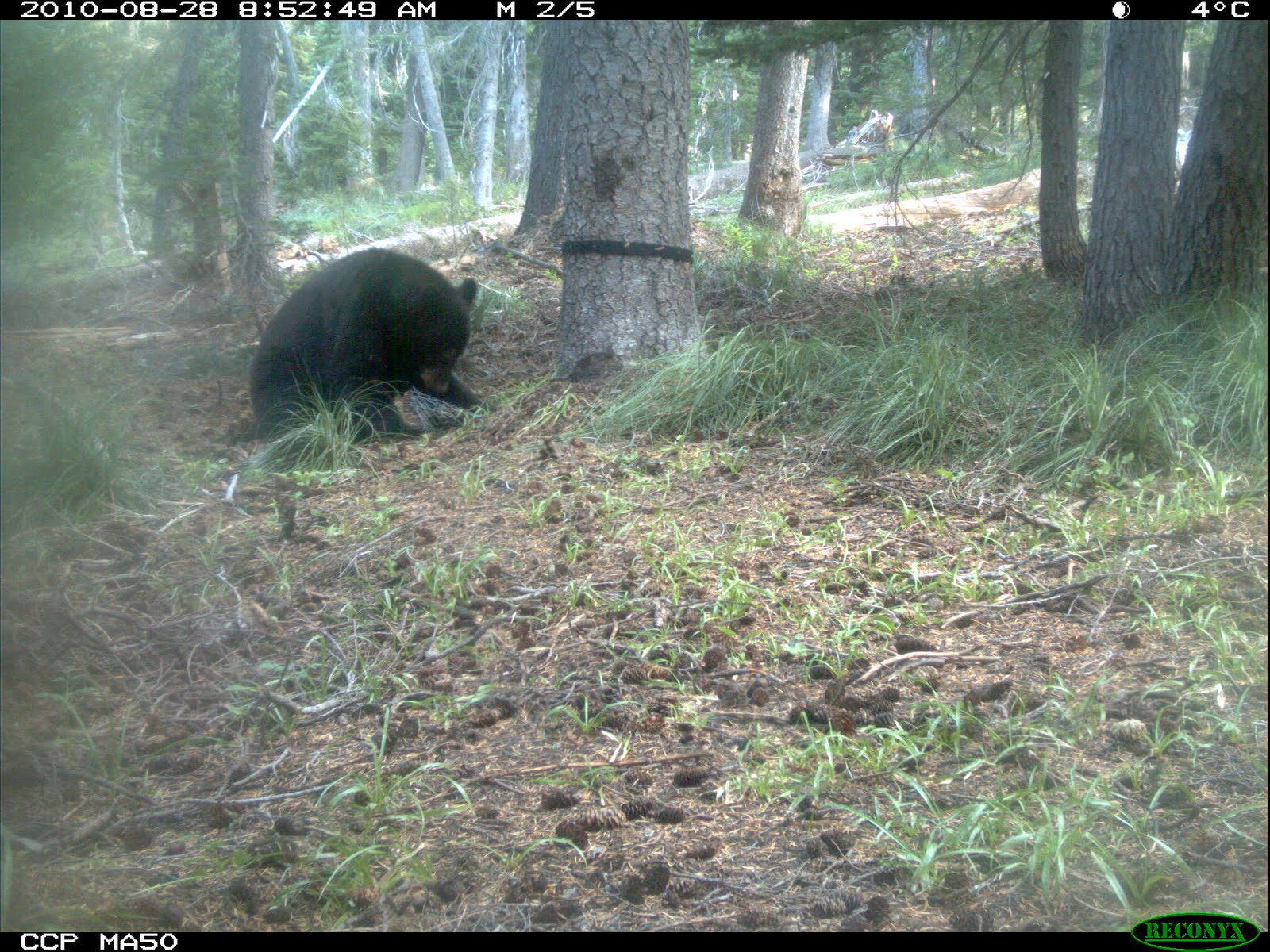
This black bear swiped the entire chicken wire bait set-up and took off to munch in privacy after a brief investigation in front of the camera.


8.15.2010

Section 3 Lake station on the east side of the Goat Rocks Wilderness

This station was set near the Section 3 Lake and Bear Creek Mountain Trailhead on Pinegrass Ridge above Rimrock Lake while the snow was still 3 feet deep.