5.30.2014

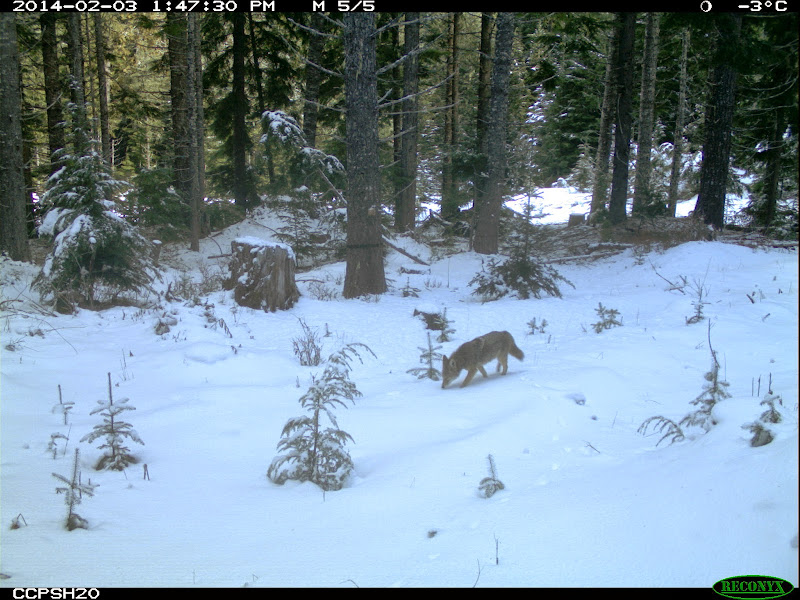
New coyote photos from Mt St Helens

This past winter, we experimented with camera surveys at and below the lower elevation bound of where we expect to find Cascade red foxes. Officially their distribution is set at 3000 to 7000 ft. However from our 200++ surveys throughout the southern half of Washington, spanning Mt Adams to Norse Peak, we have not detected these mountain foxes below 4200 ft . They have been seen as high as, well, the top of Mt. Rainier - the highest peak in their range. Generally, they occur as high as the upper subalpine and a little above where they forage in subalpine and alpine meadows and tree copses, on talus slopes, and along the base of cliff bands.

We wanted to gather some more data on how low they occur so we set 16 cameras between 2500 and 3900 ft. We don't have data back from the two 3900 ft cameras yet but all the rest yielded detections only of coyote, mountain lion, and bobcat. This absence of foxes is helping to clarify their distribution and aid in understanding where foxes live, what type of habitat variables they need for their persistence, and ultimately how predicted future climate scenarios will impact their distribution.

The coyote is the major predator and competitor of lowland red foxes and it is thought that the mountain foxes, the Cascade red fox and its Sierra Nevada and Rocky Mountain cousins, inhabit marginal, high-elevation habitats as a refuge from competition with coyotes. The new set of camera surveys will be plugged into a habitat model to investigate this coyote avoidance hypothesis.

4.07.2014

Oldies but goodies

Here are some photos from the archives.

Elk fawn between its mother's legs.

A Common Raven looking pensive.

Turkey Vulture, wings spread, are common visitors to the baited stations.

Two Whiskey Jacks flying in from the left.

3.05.2014

Elusive mountain lion in the Alpine Lakes Wilderness

Mountain lions are rare for our project to detect for two reasons. First, they tend to be much more secretive than other carnivores and second, they are generally known to occur at lower elevations than where we focus at elevations of 4000 to 6500 ft. This individual didn't hang around for long as you can see by this quick succession of two shots within a second of each other and then no more photographs. It was not interested in the bait other than the bait and scent lure bringing the mountain lion in to the station.

1.22.2014

What is it?

Anyone have any idea? Send me an email cascadescarnivore@gmail.com if you have a guess.

Two fawns in Alpine Lakes Wilderness

As field works slows down this winter and we focus on analyzing our genetic samples, I am going to begin posting some of the interesting photos from the 2013 summer field season and this winter as we check the long-term camera stations that are out now. This shot is from August.15 and I imagine these two critters are a couple weeks old. Any black-tailed experts out there?

1.08.2014

Skunk!

Striped skunk (Mephitis mephitis)..... this is the first detection of a mephitidae by our cameras. These critters generally don't occur above 6000 ft so their habitat is well within the range of our surveys. They are an omnivorous member of the Carnivora order.

11.26.2013

Welcome to Harts Pass: a wolverine comic strip

Welcome to Harts Pass: a comic strip about life (and wildlife) in Washington's North Cascades!
So describes Erik Brooks, the author of this 3 years and running comic strip from the Methow Valley News of Winthrop, Washington. This is too cool! Here is a comic strip (and storybook to come) all about one of our favorite carnivores and his critter cohort. Help support the kickstarter project here....three weeks to go!

9.21.2013

Young Cascade red fox in the Goat Rocks Wilderness

This juvenile, black Cascade red fox (also called a silver fox) was detected at a camera station in the southern Goat Rocks Wilderness. Our crews have been surveying a large area of the mountains in southern Washington since late June. We began our summer field season with 6 field biologists setting remote cameras and searching trails they were hiking for mountain fox, wolverine, and coyote scats in the Dark Divide Roadless Area, Goat Rocks, and William O Douglas Wilderness. From these locations, we expanded north, adding 4 crew members, to survey the Alpine Lakes Wilderness and then south to the Indian Heaven Wilderness and Mt Adams.
The Cascade red fox, one of the three subspecies of mountain red fox, is much more likely to produce black and cross phase individuals than the more common red phase typically observed in lowlands red foxes. It is unclear why this occurs but some hypotheses include the red coat color being selected for in the lowlands, perhaps for mating reasons, or the genes that code for red coat color hitch hiking with another gene that is beneficial in the lowlands. The assumption here is that in the mountains, this gene is not as important so all the different variants of the genes occur in approximately equal proportions - each more being equally useful (or useless). Very little research has been conducted on the mountain fox. Any investigation of the differences between mountain and lowland red foxes would be quite interesting and useful to improve our understanding of the conservation requirements of these unique mountain creatures.

9.06.2013

A couple of photographs from current stations

Granite Fire in Alpine Lakes Wilderness

2013 has been a relatively small year for forest fires in the Northwest. That being said, two fires are currently raging in our study area - the Granite Fire in the Alpine Lakes Wilderness and the Conrad Lake fire on the east side of the Goat Rocks Wilderness. This latter fire is not affecting our camera stations though it is blocking access to some of the trails we search for scats, however one of our camera stations is located in the heart of the Granite Fire and I think it may have burned down. Once the area closures are lifted, we will visit the site and let you know what we see. The photograph above shows Klonaqua lakes with the fire burning downslope.